By Kiyonga Kenneth
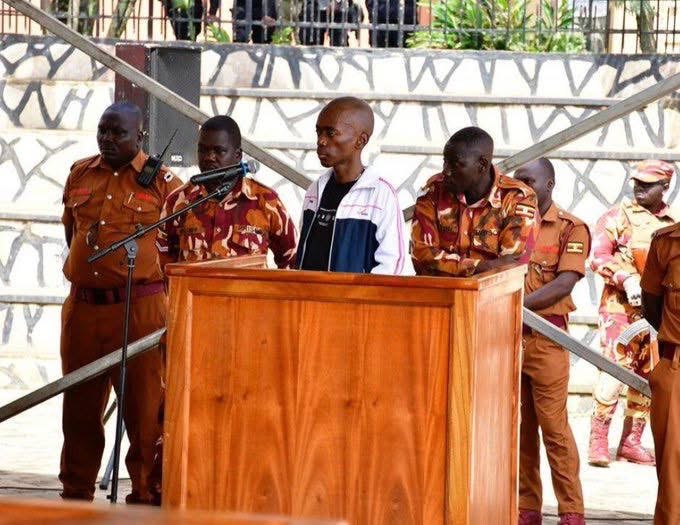
The High Court in Kampala has sentenced Christopher Okello Onyum to death for the murder of four toddlers at Ggaba Early Childhood Development Centre, in a case that has horrified communities across Uganda.
Delivering the judgment, Justice Alice Komuhangi Khaukha described the killings as falling among the “rarest of the rare” crimes, citing their calculated and premeditated nature. The victims—Eteku Gideon, Keisha Ageno Ruth, Sseruyange Ignatius, and Odeke Rayan—were all aged between one and two years.
The court heard that the murders, committed on April 2, were part of a ritualistic act aimed at acquiring wealth through blood sacrifice. Justice Komuhangi noted that the convict deliberately targeted vulnerable children who depended on adults for protection, and showed no remorse throughout the trial.
“I agree with the prosecution that this case falls in the rarest of the rare,” the judge ruled, adding that the sentence should serve as a strong warning to anyone who believes in ritual sacrifice as a path to prosperity.
Okello was sentenced to death on four counts of murder, with the punishment to be carried out in accordance with Ugandan law. He was informed of his right to appeal the sentence within 14 days before the Court of Appeal.
During mitigation, Chief State Attorney Jonathan Muwanganya urged the court to impose the maximum penalty, arguing that it would act as a deterrent and help ensure the safety of children nationwide. He referenced the case of Kato Kajubi, a Masaka businessman previously convicted of killing a child in a ritual sacrifice, to underline the gravity of such crimes.
A probation report presented by Peter Lwanga Mayanja indicated that residents of Ggaba were in shock, with many saying they had never witnessed such an incident in their community.
Parents of the victims supported the prosecution’s request for the harshest punishment, calling for justice for their children.
However, defence lawyer Sarah Awilo appealed for leniency, noting that Okello was a first-time offender who suffers from sickle cell disease and comes from a dysfunctional family background. She argued that he could still be rehabilitated and contribute to society, particularly through farming.
Okello, who remained calm during the proceedings, declined to address the court or apologise for his actions, stating only that he had nothing to say when prompted by the judge.
The sentencing was met with applause from members of the public in the courtroom, reflecting widespread anger over the killings.
Uganda last carried out civilian executions in April 1999 at Luzira Maximum Security Prison, where 28 convicts were executed, although the death penalty remains part of the country’s legal framework.