
By Nathan Eyagu
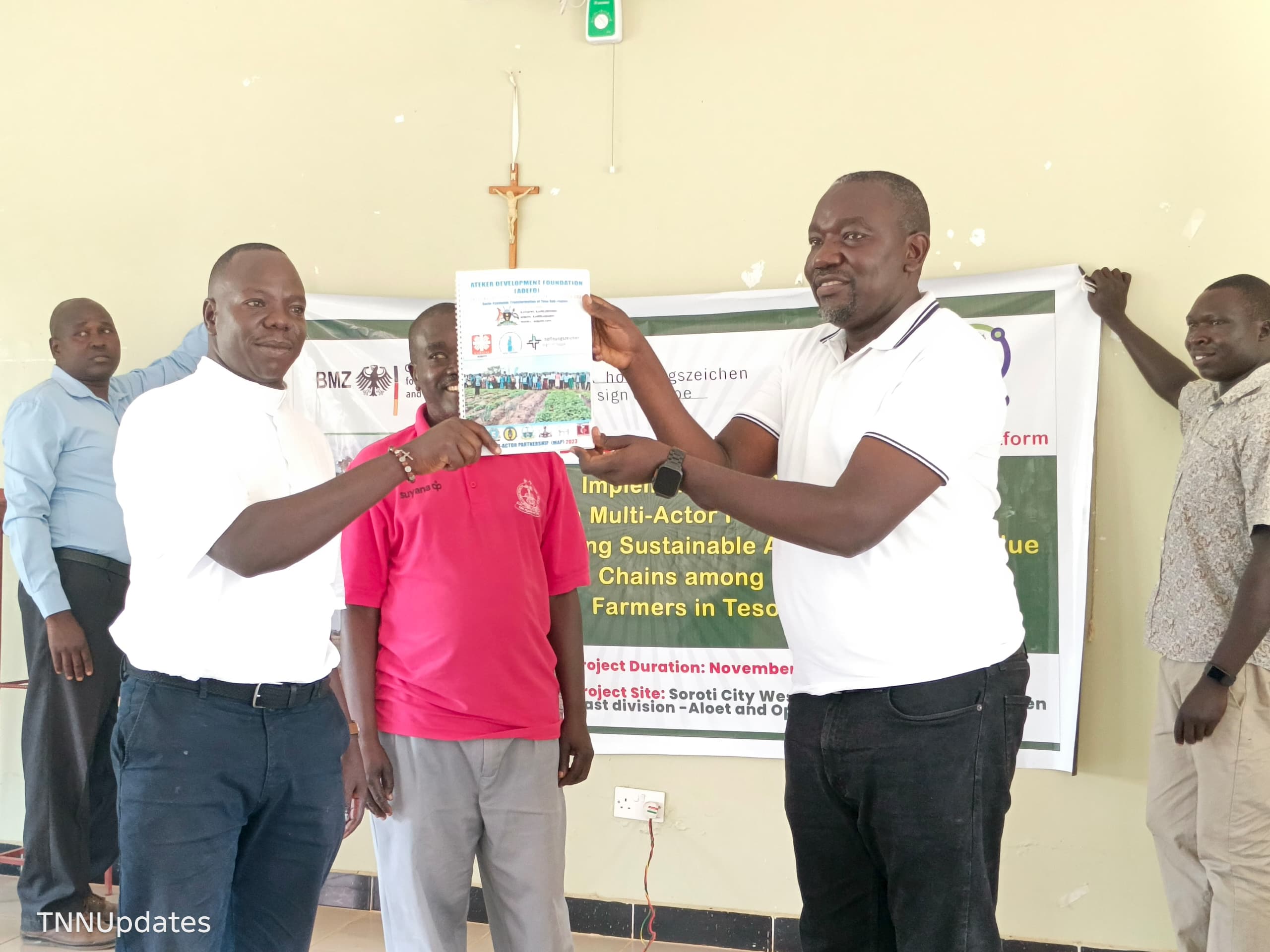
Soroti City — The Ateker Development Foundation (ADEFO), in partnership with the Soroti Catholic Diocese Integrated Development Organisation (SOCADIDO), has rolled out a UGX 4.1 billion agricultural development project aimed at transforming smallholder farming and strengthening agricultural value chains across the Teso sub-region.
The project, known as the Multi-Actor Partnership Phase II (MAP II), was officially launched at Eneku Village in Soroti City and attracted participation from development partners, researchers, local leaders, farmer groups, and civil society organisations.
MAP II seeks to promote sustainable, inclusive, and market-oriented agriculture among smallholder farmers in Teso, Eastern Uganda, with a strong focus on coordination, innovation, and local ownership through a functional multi-stakeholder platform.
ADEFO, a non-profit organisation, is implementing the project in close collaboration with SOCADIDO as the local implementing partner. SOCADIDO is the development arm of the Soroti Catholic Diocese and an affiliate of Caritas Internationalis and Caritas Uganda under the Uganda Episcopal Conference.
The project is funded by the German Federal Ministry for Economic Cooperation and Development (BMZ) and implemented in partnership with the German private organisation Sign of Hope e.V. (SoH).
Speaking during the launch, Rev. Fr. Michael Omaria, Secretariat of SOCADIDO, said the project officially started on November 1, 2025, and will run until October 31, 2029. He noted that the initiative is expected to significantly improve livelihoods in the region and attract additional development funding if successfully implemented.
The MAP II Project is currently being implemented in six districts across the Teso sub-region, with plans underway to expand coverage to ten districts and one city.
The launch was officiated by Dr. Kalule Okello David, Director of Research at the National Semi-Arid Resources Research Institute (NaSARRI) under the National Agricultural Research Organisation (NARO) in Serere District. Dr. Kalule pledged NaSARRI’s commitment to working closely with ADEFO to ensure farmers benefit through proper coordination and research-backed interventions.
He urged project implementers to clearly identify what defines the Teso region agriculturally and consolidate those strengths faster, while encouraging farmers to be innovative and increase production even on small pieces of land. He also emphasized the importance of documentation and information sharing among stakeholders to support learning and sustainability.
Dr. Kalule further encouraged farmers to take advantage of the value addition facility in Soroti City, particularly in peanut processing, noting that the facility remains underutilized due to insufficient supply of raw materials. He called on farmers to increase production, work closely with buyers, and transition into value addition. He also urged diversification into enterprises such as beekeeping by improving production levels and adopting modern farming practices.
ADEFO Chairperson Michael Odeke said the foundation is bringing together legally registered non-governmental organisations, private sector actors, and development partners to work collaboratively under one platform while retaining their independent mandates.
During the project presentation, ADEFO Project Coordinator Okiror Ben revealed that the total estimated budget for the MAP II Project stands at UGX 4,116,770,010, approximately EUR 1.09 million. The project targets 3,600 direct beneficiaries, 60 percent of whom are women, and is expected to indirectly benefit 64,800 people across the region.
The project is anchored in the Teso Master Plan 2023–2028, a strategic framework that guides coordinated development action in the region. The plan focuses on promoting smallholder agricultural value chains, strengthening farmer associations and cooperatives, and building sustainable partnerships. It aligns with Uganda’s National Development Plan IV 2026–2030 and complements the Parish Development Model and district development plans.
A feasibility study conducted under the Master Plan identified key challenges affecting farmers in Teso, including heavy reliance on subsistence and rain-fed agriculture, post-harvest losses of up to 40 percent, weak market access, and high levels of food insecurity and multidimensional poverty.
The impact of ADEFO’s interventions was highlighted by testimonies from beneficiaries such as Vincent Akol from Okocikan Sub-county, Ocomai Parish in Soroti District. A poultry farmer who benefited from Phase One of the ADEFO project, Akol said that since SOCADIDO began working with farmers in 2021, his livelihood has greatly improved.
He explained that through training and technical support, he expanded his poultry enterprise to a capacity of 1,000 birds, established regular poultry sales, and now engages in continuous sales of one-day-old chicks. He added that he plans to establish a hatchery to further boost production.
The overall objective of the MAP II Project is to improve the socio-economic situation of smallholder farmers in the Teso region through inclusive, market-oriented, and sustainable agricultural value chains supported by a functional Multi-Actor Partnership platform.
By 2029, the project aims to increase farmer incomes, strengthen cooperatives, promote gender inclusion, and build a more resilient agricultural sector capable of driving long-term development in the Teso sub-region.





Copyright ©Teso Vibez is a brand of Teso Vibez Digital (u) Ltd
.
