
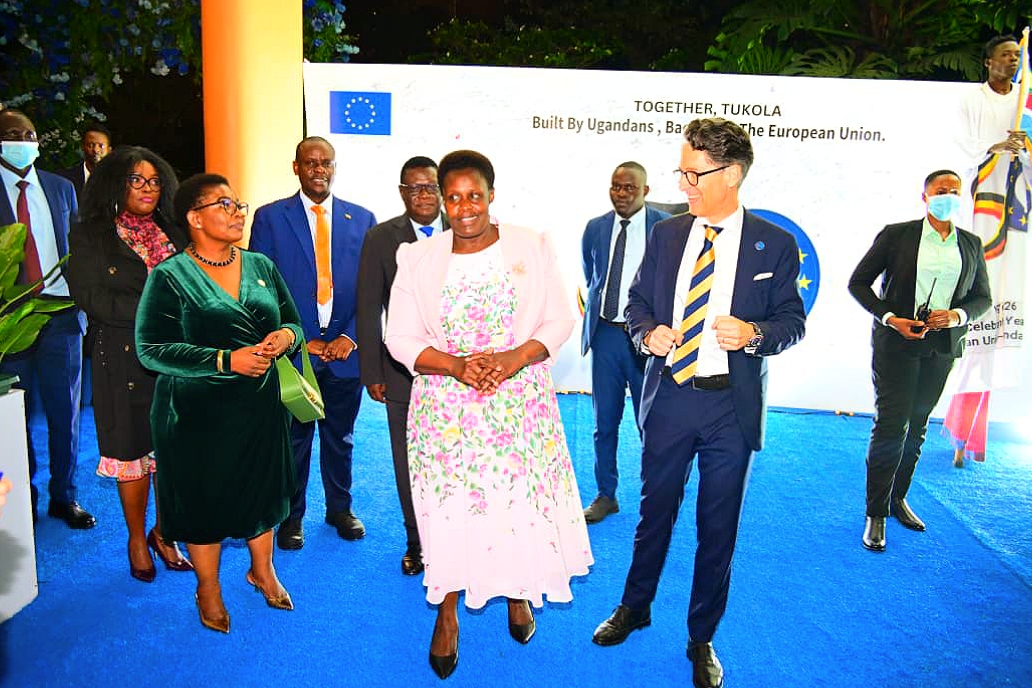
Vice President Jessica Alupo has praised the long-standing relationship between Uganda and the European Union as the two partners celebrated 50 years of diplomatic cooperation during the Europe Day 2026 celebrations held at Kololo Ceremonial Grounds.
Speaking at the event, Alupo reaffirmed Uganda’s commitment to strengthening cooperation with the European Union in areas of trade, investment, infrastructure development, technology transfer, and industrial growth.
The Vice President said the partnership between Uganda and the European Union has evolved significantly since diplomatic relations were established in 1976, describing it as a relationship built on solidarity, mutual respect, and shared prosperity.
Over the past five decades, the European Union and its Member States, working collectively under Team Europe, have contributed more than €5 billion toward Uganda’s development. According to Alupo, the support has helped improve infrastructure, energy, education, trade, and community resilience across the country.
She also commended the European Union for its continued humanitarian support to refugees and host communities, noting that Uganda hosts the largest refugee population in Africa.
“We appreciate the EU’s continued humanitarian assistance to refugees and host communities, as well as its support in strengthening our response to natural disasters and public health emergencies,” Alupo said.
The Vice President highlighted ongoing investments under the European Union’s Global Gateway strategy, including a €25 million project supporting cross-border infrastructure such as the Ntoroko lake port and the Mahagi corridor to enhance regional trade and connectivity.
In the energy sector, she noted that the €30 million rehabilitation of the Nalubaale–Kiira hydropower complex is expected to strengthen Uganda’s electricity generation capacity and support industrial expansion.
Trade between Uganda and the European Union has also continued to grow steadily. Alupo revealed that Uganda’s exports to the EU reached an estimated €1.5 billion in 2025, driven mainly by coffee exports and increasing fish exports to European markets.
She said Uganda remains committed to achieving middle-income status under Vision 2040 and is making steady progress toward graduating from the Least Developed Country category.
However, she noted that the transition presents challenges related to trade preferences and market access, emphasizing the importance of continued cooperation with the European Union.
“Instruments such as the Everything But Arms initiative and the Generalized System of Preferences continue to provide valuable support for Uganda’s export competitiveness,” she said.
Alupo stressed the need for industrialization, manufacturing, and value addition to create employment opportunities and strengthen Uganda’s economy. She added that the €1.4 billion investment roadmap offers an opportunity to advance mineral value addition, digital innovation, skills development, and private sector growth.
On behalf of the Government and people of Uganda, Alupo expressed gratitude to the Europ







Copyright ©Teso Vibez is a brand of Teso Vibez Digital (u) Ltd
.