
By Nathan Eyagu
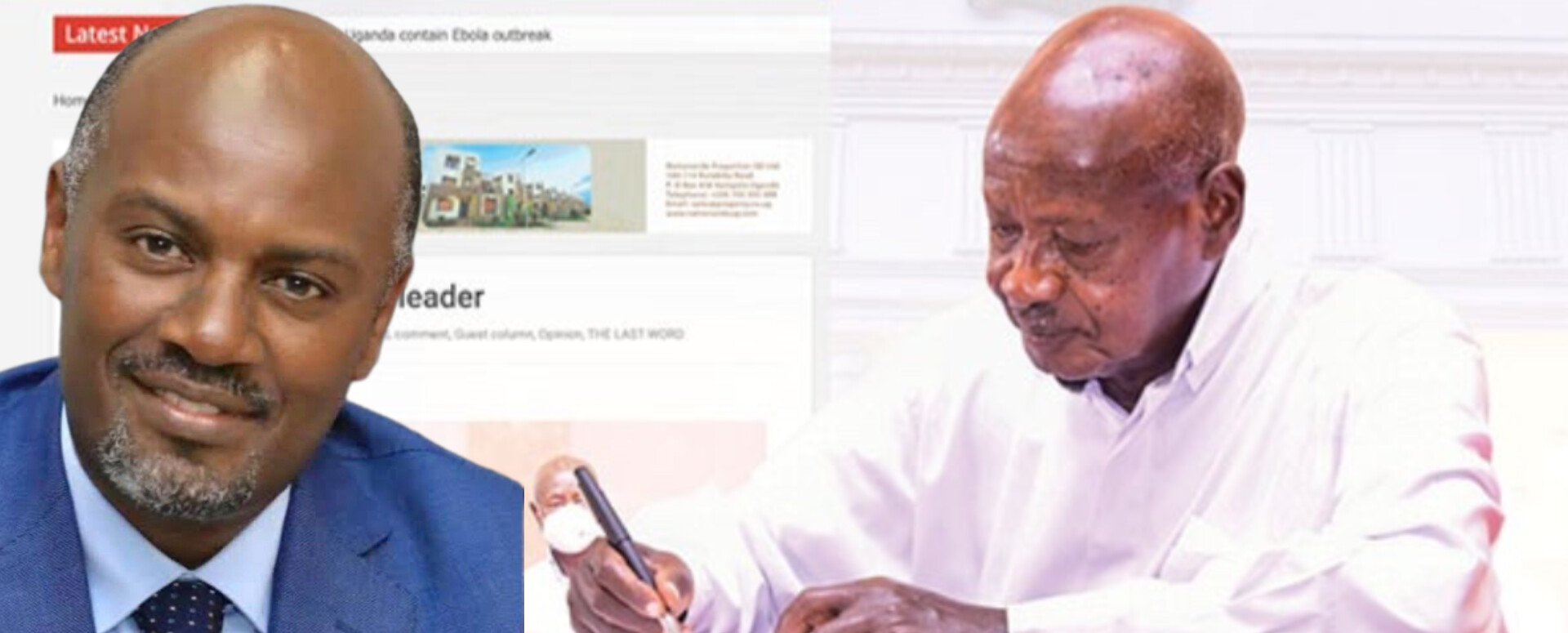
KAMPALA — President Yoweri Kaguta Museveni has launched a fierce public attack against veteran journalist and political commentator Andrew Mwenda, accusing him of undermining Uganda’s economic transformation and serving neo-colonial interests.
In a strongly worded statement released on social media, Museveni dismissed claims questioning his judgment and age, declaring that despite being 82 years old, he remained fully capable of defending both himself and the country.
“Mr. Mwenda, thank you for declaring me senile and incapable of judging right,” Museveni wrote. “You will, however, discover that at 82, I am still able to defend Uganda and myself with the Bible, the AK-47 and the pen.”
The President’s remarks followed criticism from Mwenda regarding government-backed economic and industrial projects, some of which have faced scrutiny over funding, viability and implementation.
Museveni defended several local entrepreneurs and innovation initiatives, challenging journalists to investigate factories, agricultural projects and herbal medicine ventures operating in different parts of the country. He argued that critics routinely ignore successful Ugandan-owned enterprises while promoting narratives that discourage local industrialization.
The Ugandan leader also strongly defended Kiira Motors Corporation, describing criticism of the state-backed automotive project as evidence of a wider “neo-colonial” mindset that seeks to keep African economies dependent on raw material exports.
According to Museveni, Uganda’s strategy of value addition and industrialization has already begun producing results in sectors such as coffee, gold refining, dairy production, steel manufacturing and palm oil processing.
He cited Uganda’s decision to ban exports of unprocessed minerals, saying the policy had led to the establishment of 10 gold refineries and significantly boosted export revenues. Museveni also pointed to rising coffee exports and increased milk production as evidence that government wealth-creation programs were succeeding.
The President further accused Mwenda of damaging investor confidence by exposing internal government discussions and Cabinet matters on social media. He alleged that such actions risked frightening away development partners and investors at a time when Uganda’s economy was experiencing growth.
Museveni also revived long-standing disagreements surrounding the Bujagali hydropower project, accusing Mwenda and other critics of contributing to delays and electricity shortages in the early 2000s after opposing a proposed partnership with AES Corporation.
Throughout the statement, Museveni portrayed himself as a steadfast defender of patriotism, Pan-Africanism and socio-economic transformation, insisting that Uganda’s progress had continued despite opposition from critics and what he described as “saboteurs.”
Drawing from Uganda’s liberation struggle, the President compared national development efforts to military campaigns that often require persistence through failure before eventual success.
He concluded with a traditional Banyankore proverb encouraging perseverance, arguing that true patriots should support Uganda’s development journey rather than discourage it.
The exchange has sparked widespread debate across Uganda’s political and media circles, with supporters praising Museveni’s defense of local industrialization while critics accused the President of using inflammatory language against dissenting voices.




Copyright ©Teso Vibez is a brand of Teso Vibez Digital (u) Ltd
.