
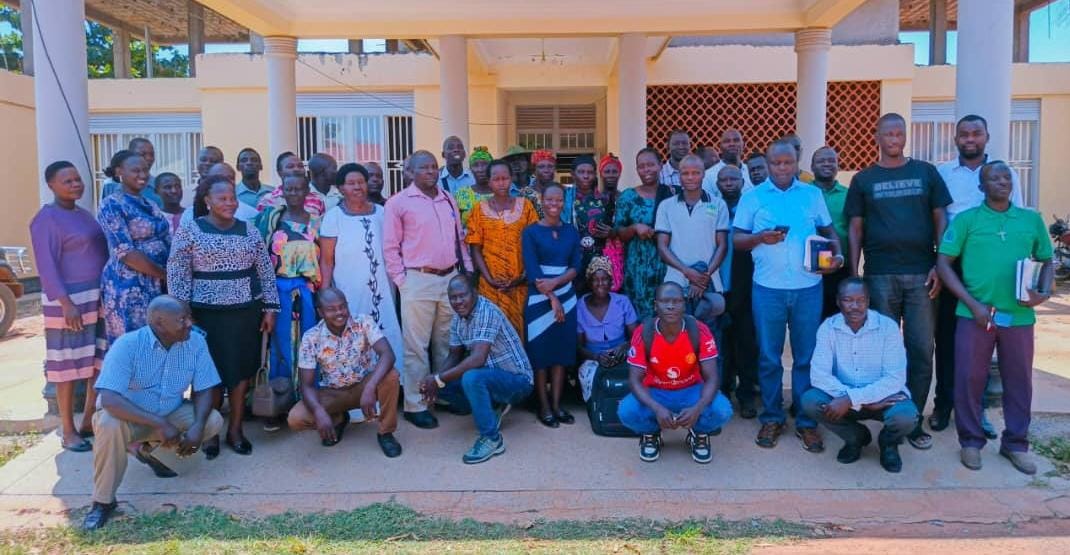
Soroti District - A four-year, UGX 4.1 billion agricultural transformation initiative aimed at shifting farming from subsistence to a profitable business model has been officially launched in Soroti District.
The Multi-Actor Agribusiness Platform Phase II (MAP II) Project, implemented by the Ateker Development Foundation (ADEFO) in partnership with SOCADIDO, was launched at Soroti District Headquarters, drawing participation from district political leaders, technical staff, extension workers, farmer representatives, private sector actors, civil society organisations, and media partners.
The project, Project No. P8311 DC–UGA25.02, will run from 1 November 2025 to 31 October 2029 and targets 3,600 smallholder farmers, 60 percent of whom are women. It is expected to indirectly benefit 64,800 people across the Teso sub-region.
Speaking at the launch, Mutai Victor, the Assistant Resident District Commissioner (RDC) for Soroti District, called for a fundamental change in mindset toward agriculture, urging communities to embrace farming as a viable business venture.
“Farming should no longer be viewed as a subsistence activity. It is a business that can generate income and transform livelihoods,” Mutai said.
He noted that despite agriculture being a major economic opportunity, men have increasingly distanced themselves from productive farming, leaving much of the work to women.
“Sixty percent of the beneficiaries are women because they are the most active in agriculture. But men must also be brought back to farming. Political seasons are over; the rainy season is here,” he emphasized.
To strengthen knowledge transfer, the Assistant RDC proposed the establishment of demonstration farms in every sub-county, where farmers can learn best agricultural practices such as spacing, fertilizer application, and pest management.
“Quality production is what the market demands. Demonstration gardens will help farmers adopt the right practices and improve competitiveness,” he added.
Jessica Florence Akiteng, the District Woman Councillor for Aukot Sub-county and Secretary for Production and Natural Resources, welcomed the rollout of MAP II, citing positive outcomes from the first phase.
“Our farmers gained skills, improved their practices, and strengthened their engagement with value chains during Phase I. Phase II gives us an opportunity to deepen these gains,” Akiteng said.
She called for the expansion of the project to additional sub-counties to ensure wider impact.
According to Ben Boham Okiror, the ADEFO Project Coordinator, MAP II is funded by the German Federal Ministry for Economic Cooperation and Development (BMZ) and implemented in partnership with the German private organisation Sign of Hope e.V.
The project budget stands at UGX 4,116,770,010 (approximately EUR 1.09 million) and focuses on promoting sustainable, inclusive, and market-oriented agriculture through a functional multi-stakeholder platform.
In Soroti District, implementation will focus on Awaliwal and Ocokican sub-counties, working closely with district extension staff, parish chiefs, and local leaders.
A feasibility study conducted under ADEFO identified major challenges affecting farmers in the Teso sub-region, including heavy reliance on rain-fed agriculture, post-harvest losses of up to 40 percent, weak market access, and high levels of food insecurity and poverty.
“These challenges require coordination, cooperation, and joint learning across the entire value chain,” Okiror said.
Gender inclusion remains central to the project, with commitments to women’s participation in leadership, planning, and decision-making processes. MAP II also emphasizes district ownership and sustainability beyond donor support.
Esatu Moses, Principal Assistant Secretary for Soroti District, urged stakeholders to take responsibility for ensuring continuity.
“This project must be owned by the district. Knowledge gained here must be shared widely so that even after partners exit, the systems remain functional,” he said.
The MAP II Project is anchored in the Teso Master Plan 2023–2028 and aligns with Uganda’s National Development Plan IV, complementing the Parish Development Model and district development plans.
As implementation begins, leaders expressed optimism that MAP II will strengthen farmer cooperatives, improve market access, enhance value addition, and ultimately position agriculture as a profitable and sustainable business capable of lifting households out of poverty in Soroti District and the wider Teso sub-region.









Copyright ©Teso Vibez is a brand of Teso Vibez Digital (u) Ltd
.
